What Makes a Good Character Design a Guide for Creators
Discover what makes a good character design, from iconic silhouettes to color psychology. Learn the principles to create memorable characters that connect.
A truly great character design is more than just a pretty picture. It's a form of visual shorthand, blending a distinct silhouette, deliberate shape language, and a hint of a story to forge an immediate bond with anyone who sees it. It’s the art of making a character's outside match their inside, ensuring they're not just seen, but remembered.
The Hidden Language of Character Design
Ever wonder why you can instantly recognize Mickey Mouse from just three circles, or why Darth Vader’s sharp, angular helmet feels so menacing? That’s not an accident. The secret behind characters that stick with you is strategic communication. A brilliant design tells you who a character is in a single glance, turning a drawing into a personality people can connect with, follow, and even buy from.
In the endless scroll of today's digital world, that instant recognition is gold. Good character design is what separates the noise from the signal, determining who gets noticed and who gets monetized. We're talking about a global content market worth well over a hundred billion dollars. The character licensing part of that pie alone was valued at roughly $130.4 billion and is expected to soar to $224.5 billion by 2033, according to market analysis from Dataintelo.
For creators, a unique virtual influencer or avatar becomes a powerful asset. That design can be stamped on merchandise, featured in branded content, and used in exclusive fan experiences, building a real business around a digital personality.
If your character can't be identified in less than two seconds on a fast-scrolling feed, the design has failed. It’s the first and most crucial test in modern character design: the ability to cut through the digital clutter.
This guide will unpack the core principles that separate the forgettable faces from the unforgettable icons. We'll get to the heart of what makes a character design work, proving that creating a memorable persona isn't some mysterious magic—it's a craft you can learn.
The Core Pillars of Good Character Design
Before we jump into the deep end, let's get a bird's-eye view of the foundational pillars we'll be covering. Think of these as the essential ingredients. Each one builds on the last to create a character that feels whole, believable, and impactful.
| Principle | Why It Matters | Quick Example |
|---|---|---|
| Silhouette & Shape | It's the first thing people see. A strong, unique outline makes a character instantly recognizable, even from a distance or as a tiny icon. | The sharp, triangular silhouette of Maleficent's horns and collar immediately signals "villain." |
| Color & Contrast | Colors trigger emotions and guide the eye. A well-chosen palette sets the mood and highlights the most important features. | The vibrant red and blue of Superman's suit feels heroic, hopeful, and distinctly American. |
| Personality & Backstory | This is the "why" behind the design. The character's history and personality inform everything from their clothes to their posture. | Indiana Jones's worn leather jacket and fedora tell you he's a rugged, world-weary adventurer. |
| Adaptability | A great design holds up everywhere—on a giant billboard, a tiny app icon, a t-shirt, or a 3D model. | The simple, bold design of a Minion works perfectly as a toy, a sticker, or in an animated film. |
Getting these pillars right is the key to creating a character that doesn't just look good but also performs well. Throughout this guide, we'll break down each one with practical tips and real-world examples.
One of the most important elements here is the backstory. It’s so foundational that it deserves its own deep dive—you can learn more about translating a character's story into a visual identity in our guide on how to create a branding guide.
Mastering Silhouettes and Shape Language
Ever notice how you can identify your favorite characters from just their shadow? That's the magic of a strong silhouette. It’s the clean, dark outline of a character, and it’s the single most important test for an instantly readable and memorable design.
If you can't tell who a character is when all the details are blacked out, the design just isn't working. Think of the "Mickey Mouse ears test"—those three simple circles are recognized across the globe. It's proof that a unique outline is your most powerful tool for immediate recognition.
Once you have that outline, the specific shapes within it start telling a story of their own. This is what designers call shape language.
The Psychology of Basic Shapes
We're all hardwired to react to basic shapes in certain ways. As a designer, you can use this to your advantage, aligning a character’s visual form with their personality.
- Circles and Ovals: These shapes are all about softness. They feel harmless, friendly, and approachable. Their lack of sharp edges is why characters like Kirby or the Minions seem so innocent and fun.
- Squares and Rectangles: Solid and stable, squares communicate strength, reliability, and sometimes a bit of stubbornness. Think of Superman's broad, square chest or even Mike Wazowski from Monsters, Inc.—he's a sturdy, dependable friend.
- Triangles and Sharp Angles: Pointed shapes are a signal. They can mean danger, aggression, or just pure dynamism. Villains like Maleficent are dripping with sharp angles, while fast-moving heroes like Sonic the Hedgehog use triangles to feel quick and energetic. For a deeper dive, our guide on how to create a superhero avatar puts these ideas into practice.
This whole process—from a simple outline to a fully realized character—is built on these foundational choices.
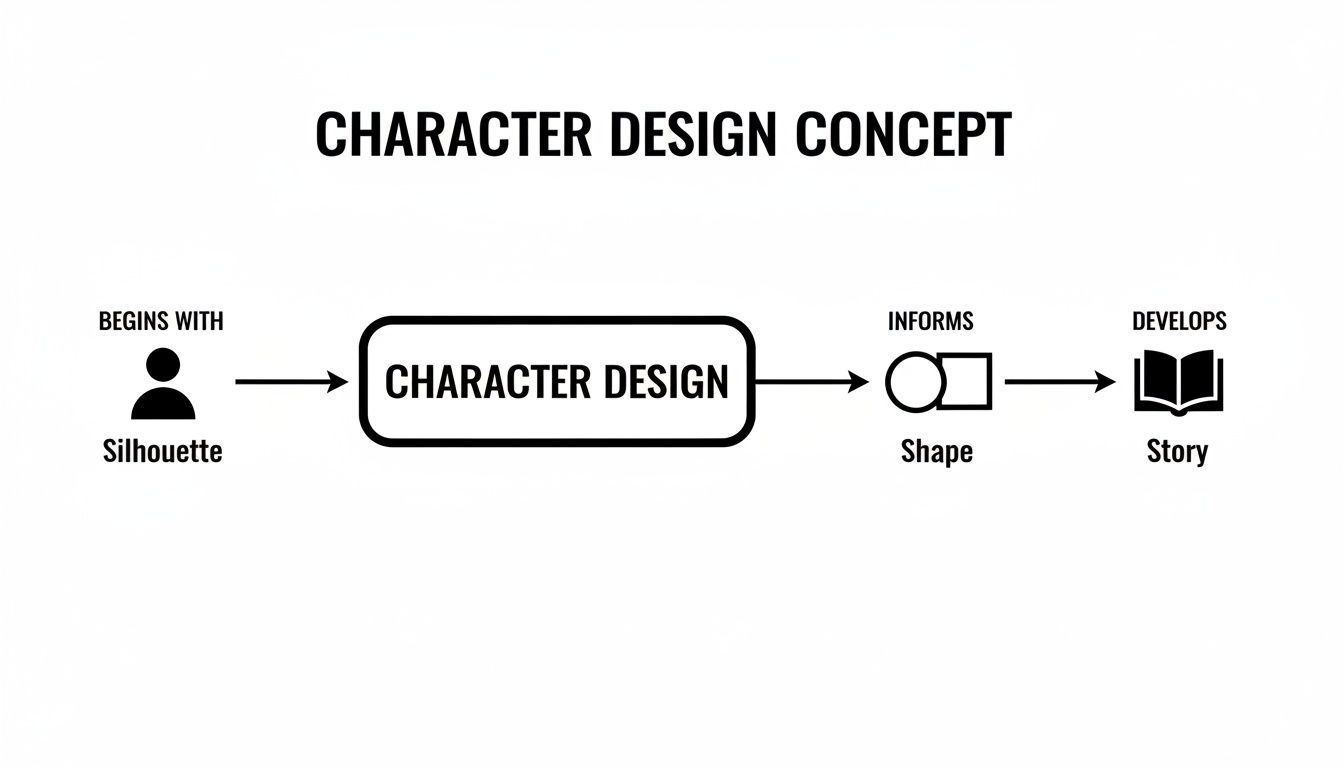
As you can see, a great design isn't just about the cool details; it starts with a rock-solid, readable foundation.
Why Strong Shapes Matter for AI and 3D
Getting these fundamentals right is more critical than ever. The global animation market is valued at around £372.4 billion, and computer-generated animation makes up about 85% of that pie. A character with a weak or mushy form will get lost in translation when you move to 3D models or AI-generated imagery, where subtle details can easily be overlooked.
A character with clear shapes and a defined silhouette is not just an artistic choice; it's a strategic one. It ensures your creation remains impactful whether it's a 3D model, a social media icon, or a piece of merchandise.
By mastering silhouettes and shapes, you're not just drawing a character; you're building a brand. You’re crafting an icon that can be recognized in a split second and remembered for years. This is the first, most crucial step in creating a truly great character design.
Telling a Story with Color and Contrast
If a silhouette is the skeleton of your character, color is the soul. It's the fastest way to communicate emotion and personality, instantly telling an audience if someone is a friend or a foe, a hero or a villain. Before your character even says a word, their color palette has already started the conversation.
Think of it as a subconscious language. Bright, sunny yellows and oranges practically scream optimism and energy, making them perfect for an upbeat hero. On the flip side, deep blues, muted grays, and dark purples can suggest mystery, sadness, or a more serious nature. This isn't just an artistic flourish; it’s a storytelling shortcut that works every time.
Guiding the Eye with Smart Contrast
Contrast is your visual tour guide. It tells the viewer’s eye exactly where to look and what to focus on. Without good contrast, a design can feel flat and confusing. With it, you can spotlight the most important parts of your character, from their expressive face to a signature weapon.
There are three main flavors of contrast you'll want to master:
Value Contrast: This is the difference between light and dark. A strong value contrast is king for readability, ensuring your character's key features don’t get lost. Think about how a character's face or a crucial accessory pops against the rest of their outfit.
Color Contrast: This is all about playing with colors on opposite sides of the color wheel, like red and green or blue and orange. Using complementary colors creates a dynamic, high-energy vibe that immediately grabs attention.
Saturation Contrast: This is a more subtle but powerful trick. By placing a vibrant, intense color next to a muted, dull one, you make the bright color explode off the screen. It's a fantastic way to draw the eye to a single, crucial detail, like a glowing amulet or the glint in a character's eye.
The best character designs almost always use a limited color palette. A simple scheme of three or four core colors builds a much stronger and more memorable identity than a chaotic mess of every color imaginable.
A well-planned color scheme is absolutely vital for a digital avatar. On a busy social media feed, high-contrast colors help your character stand out from the noise and stay legible, even as a tiny profile icon. To really dig into this, it’s worth exploring the power of color in crafting visual identity. When you're deliberate with every hue, your character's design doesn't just look good—it tells a compelling story.
A great-looking character is just an empty shell if there's no one home. You can nail the silhouette, pick the perfect colors, but what really makes an audience lean in is the story. It's the personality, the history, and the goals bubbling under the surface that forge a real connection. This is where you ground every design choice in a solid narrative, making sure every visual element is there for a reason.
Your job isn't to just list off personality traits; it's to show them. Does your character have a rebellious streak? Maybe that comes through in a choppy, asymmetrical haircut or a beat-up leather jacket plastered with patches. Or perhaps they're shy and cautious? You could show that with muted, layered clothes that help them fade into the background.
This whole process is about constantly asking "why." Why those specific boots? Maybe they’re a clue that she grew up somewhere rugged and unforgiving. Why is his posture so ramrod straight? It could be a holdover from a military past. Every answer weaves another thread into a cohesive design, making every piece feel deliberate and earned.
Building a Narrative Blueprint
You don't have to write a 1,000-page epic to give your character depth. A simple, solid backstory is all you need to act as a blueprint for your design. It gives you a logical framework to hang your choices on, making the final creation feel authentic and believable. This narrative foundation is one of the most powerful tips for character design you'll ever use.
To start building your character’s inner world, ask yourself a few core questions:
- What drives them? Are they after money, justice, or just plain survival? This core motivation will shape their expressions and even the gear they carry.
- What are they terrified of? This can manifest in subtle ways, like a nervous tic or an unexplained aversion to a certain color.
- Where are they from? Their home—whether a neon-drenched cyberpunk city or an enchanted forest—will have a massive impact on their clothing, materials, and overall style.
Taking these foundational ideas from concept to a polished visual is where technology can be a huge help. Using AI 'sketch to real' tools can help you rapidly visualize how these narrative beats translate into an actual design.
Platforms like CreateInfluencers are built for this, letting you bake these backstory elements right into your prompts. This way, the characters you generate already have their story woven into their appearance.
A character's history is written on their body and their clothes. Scars tell stories of past battles, worn-out gear speaks of long journeys, and a pristine uniform signals discipline and order.
Following this inside-out approach is what elevates a design from a collection of cool-looking parts into a believable person. It's what makes your audience feel like they know the character, creating a bond that goes way deeper than just appreciating a cool drawing.
Adapting Your Design for Any Platform
A great character design has to be able to go anywhere. That stunningly detailed avatar might look amazing on a 4K monitor, but what happens when you shrink it down to a tiny profile icon on Instagram? It can easily turn into an unreadable smudge. The real test of a strong design is whether it holds up in every context, from a full-sized virtual influencer profile to a blink-and-you'll-miss-it TikTok video.
This is what separates the good designs from the truly professional ones. You're aiming for a visual identity that's both tough and flexible—something that stays clear and memorable, no matter the size or medium. To get there, you have to nail what makes your character instantly recognizable: their core silhouette, dominant colors, and maybe one or two standout features.

Designing for Small Screens
We live on our phones, so designing for small screens isn’t a nice-to-have; it’s a necessity. People scroll fast, giving you just seconds to make an impression. Clarity is everything. A design overloaded with tiny, intricate details just becomes visual noise on a phone.
To make sure your character always pops, even on a tiny screen, you need to:
- Simplify the Details: Think big, readable shapes, not complex patterns or fine textures. A good rule of thumb: if you can't see a detail in a thumbnail, it's probably not worth keeping.
- Boost the Contrast: High contrast is your best friend. It keeps your character legible, both against the background and within the design itself, especially at small sizes.
- Emphasize Key Features: What’s the one thing that defines your character? Is it their wild hair, a signature hat, or maybe a unique pair of glasses? Whatever it is, make sure it’s clear and maybe even a little exaggerated.
This goes beyond static images, too. With video, especially short-form content, ruling the social media world, your design needs to be just as recognizable in motion. If you're diving into AI-driven video, our guide to the best AI video creation tools can help you make sure your adaptable character truly shines.
Planning for Monetization and Merch
A flexible design also opens up way more doors for making money. It's much easier to turn a character with distinct, "ownable" features into merchandise like t-shirts, stickers, or even collectibles.
An adaptable character design isn't just about aesthetics; it's a powerful brand asset. When a character can seamlessly transition from a digital screen to a physical product, its value and reach increase exponentially.
Just look at the massive anime market, which is projected to hit USD 220.38 billion by 2035. Its merchandising side is also expected to climb to USD 18.68 billion by 2030, with figurines alone making up over 37% of that. This just goes to show that audiences crave tangible versions of the characters they love—characters with instantly recognizable silhouettes and outfits.
By investing in a specific look—whether it's streetwear, K-pop, or Old Money—you give your character a distinct brand that can support themed photo packs and merchandise lines. Thinking about this adaptability from day one means you're building a character that's ready for any platform and any opportunity that comes your way.
Your Character Design Checklist and Common Mistakes
So, you've learned the theory behind what makes a character pop—the secrets of silhouette, the power of color, and the magic of a good story. But how do you actually put it all together? Let's bridge that gap between knowing and doing with a practical checklist and a heads-up on the common mistakes that trip up even seasoned creators.
Think of this as your pre-flight check before launching a new character. Run through these questions to spot any weak points and make sure your design is ready for the spotlight.
- The Silhouette Test: If you blacked out your character completely, could someone still tell who it is just from the outline? It needs to be distinct.
- Color Harmony: Are you sticking to a tight palette of 3-4 core colors? Do those colors actually feel like your character?
- Personality Cues: Does every piece of their outfit, every accessory, and even the way they stand tell a consistent story about them?
- The Tiny Icon Test: How does your design look when it’s shrunk down to a social media profile picture? If it becomes a blurry mess, it’s not working.
Side-Stepping Common Design Traps
Knowing what to do is half the battle; knowing what not to do is the other half. It's surprisingly easy to fall into a few classic design traps, but once you learn to recognize them, you can steer clear.
The number one mistake I see is over-designing. It’s tempting to keep adding more belts, more glowing bits, more accessories. But all that clutter just creates visual noise, making your character hard to look at and even harder to remember. Keep it simple and focused.
Right behind that is a reliance on tired clichés. A brooding anti-hero in a black trench coat? A quirky, bubbly girl with pigtails? We've seen it all before. While archetypes are a great starting point, you have to add a unique twist to make your character feel fresh and stand out from the crowd.
Finally, a muddled color palette can sink a great design instantly. Throwing too many competing colors together or using tones that clash will make the final result look amateurish and jarring. It's also worth remembering that different platforms have their own rules that might shape your creative choices, which you can learn more about in our guide to the Character AI NSFW policy.
To make these points crystal clear, let's look at some common design problems and how to fix them.
Good vs. Bad Character Design Choices
| Design Element | Common Mistake | Effective Solution |
|---|---|---|
| Silhouette | A generic, symmetrical human shape that blends in. | Exaggerated features, unique hair, or iconic accessories that create a distinct outline. |
| Color | Using a dozen bright, competing colors that clash. | A limited palette of 3-4 colors with a clear dominant, secondary, and accent color. |
| Detail | Covering the character in complex patterns and gear. | Focusing detail in one or two key areas (like the face or a weapon) to guide the eye. |
| Personality | Relying on overused tropes without any unique spin. | Subverting a cliché; for example, a giant brute who loves to bake or a princess who's a master mechanic. |
At the end of the day, it's about making smart, intentional choices.
The goal of a great design isn't just to look cool—it's to communicate clearly. Every choice should serve the character's story and ensure they are memorable, from a full-screen splash to a tiny icon.
By using this checklist and keeping an eye out for these common pitfalls, you’ll be in a much better position to troubleshoot your own work and create characters that are not just beautiful, but truly effective.
Frequently Asked Questions About Character Design
Jumping into character design always brings up a few common questions, especially when you're building an AI persona for social media. Let's tackle some of the most frequent sticking points and clear things up.
How Important Is a Backstory for a Social Media Avatar?
Think of it this way: your backstory is the character's DNA. It’s what keeps them consistent—from their personality and fashion sense to the way they react in different situations. A backstory is the difference between a forgettable digital puppet and a believable AI influencer who people actually want to follow.
For instance, a simple premise like "ex-coder turned world traveler" gives you a ton of creative fuel. You can imagine her in practical but stylish gear, maybe with a few favorite tech gadgets, always looking confident and ready for the next adventure. Every post feels true to who she is.
Can I Use the Same Character Across Different Platforms?
Absolutely, but the key is adaptation, not duplication. The core design—the silhouette, the color palette, the signature features—should stay the same so people recognize your character instantly. But the context of your content needs to fit the platform.
Your Instagram might be full of bright, aspirational lifestyle shots. Over on a platform like Fanvue, the content might be more exclusive and personal. A truly great design is flexible enough to feel at home anywhere without losing its identity.
What Is the Fastest Way to Test My Character Silhouette?
The "fill test" is your best friend here. It’s simple: take your character’s image and fill it in with solid black. Now, step back and look at the shape. Is it unique? Can you tell what kind of character they are just from that outline?
If the silhouette is just a generic human-shaped blob, it’s time to rethink things. Go back and tweak the pose, add a signature accessory, or exaggerate the hair to create an outline that’s instantly memorable.
How Do I Choose Good Colors Without Being an Expert?
You don't need a degree in color theory. Just start with a single word that captures your character's vibe—like ‘energetic,’ ‘calm,’ or ‘luxurious.’ A quick search for "color psychology" will point you to colors tied to that feeling (yellow for energy, blue for calm, purple for luxury).
From there, use a free online color palette generator to find a few shades that work well together. Sticking to three or four core colors is a pro move. It keeps the design looking polished and intentional, not messy.
Ready to put these ideas into practice? With CreateInfluencers, you can design and generate your own unique AI characters in minutes. Define their personality, lock in their style, and start creating stunning content that gets noticed. Get started for free today and bring your vision to life.