What Is an AI Girlfriend A Guide to Virtual Companionship
What is an AI girlfriend? This guide explains the technology, real-world uses, and social impact of AI companions, from chatbots to virtual influencers.

So, what exactly is an AI girlfriend? It's not a physical robot, but rather a digital companion powered by artificial intelligence. Think of it as an incredibly interactive partner that gets to know you, learning from your conversations to create an experience that can feel surprisingly personal.
Demystifying the AI Girlfriend
At its heart, an AI girlfriend is a program built to simulate a human-like relationship through text, voice, and sometimes even visuals. It’s less like talking to a machine and more like interacting with an advanced video game character or a very smart digital pen pal.
These companions are powered by complex algorithms that do more than just spit out pre-written replies. They can remember things you've told them, pick up on emotional cues in your messages, and generate unique responses that help build a genuine sense of connection over time.
This isn't a one-size-fits-all technology, either. You can find AI companions across a whole spectrum of complexity, from a simple chat app on your phone to a fully-realized virtual influencer who seems just as real as anyone else on your social media feed.
The Different Faces of AI Companionship
The term "AI girlfriend" is really a catch-all for a few different types of digital partners. Each one offers a different level of realism and interaction, blending conversational AI with generated images or video. A lot of this builds on the concept of a virtual model, so understanding that is a great starting point.
Here are the main types you'll come across:
- Chatbot Companions: These are the most straightforward—primarily text-based AIs designed for conversation. They're great for providing a bit of emotional support, engaging in some lighthearted banter, or just being a non-judgmental ear when you need one.
- Avatar-Based Partners: This is a step up. These companions have a visual form, usually a 2D or 3D avatar. Having a face to connect with adds a whole new layer, making roleplaying and virtual dating feel much more present and engaging.
- Photorealistic Influencers: This is the most advanced version, where AI generates a persona that looks and acts completely real. These digital people are powered by something called https://createinfluencers.com/blog/what-is-synthetic-media, which is all about creating incredibly realistic digital content. These influencers run their own social media accounts, engage with followers, and can even become full-fledged brands.
To make it a bit clearer, here’s a quick breakdown of how these different types stack up.
| Companion Type | Main Platform(s) | Primary Use Case |
|---|---|---|
| Chatbot Companion | Mobile Apps, Messaging | Emotional support, conversation |
| Avatar-Based Partner | Specialized Apps, VR | Interactive roleplay, virtual dating |
| Photorealistic Influencer | Instagram, Fanvue, TikTok | Content creation, brand marketing |
Ultimately, what an AI girlfriend is really depends on how it’s built and what you're looking for. For some, it’s a tool to ease loneliness. For others, it's a creative outlet for storytelling or even a professional way to build a digital brand from the ground up.
The Technology Behind Your Virtual Companion
Ever wonder how an AI companion can chat with you so naturally? It’s not magic—it's a clever combination of a few powerful technologies working in harmony. The heart of it all is Natural Language Processing (NLP), which basically acts as the AI's ears and mouth.
Think of NLP as the bridge between your human language and the AI's computer brain. It takes what you type, figures out the meaning, context, and even your mood, and then helps the AI formulate a response that sounds like something a person would actually say. It’s what separates a real conversation from just spitting back pre-programmed answers.
The Brains of the Operation: Large Language Models
If NLP is the bridge, then a Large Language Model (LLM) is the brain on the other side. This is where the real intelligence comes from. Imagine an AI that has devoured a massive chunk of the internet—books, articles, forums, you name it. It hasn't just read the words; it has learned the intricate patterns of how we communicate.
This is why your AI girlfriend can understand slang, pick up on subtle jokes, and carry a conversation that flows naturally. When you send a message, the LLM analyzes it and predicts the most logical, engaging, and human-like response. It’s this predictive power that allows for those surprisingly deep, open-ended chats that can go in any direction.
The visual below breaks down how these core technologies are the foundation for all types of AI companions, from text-based bots to fully realized virtual characters.
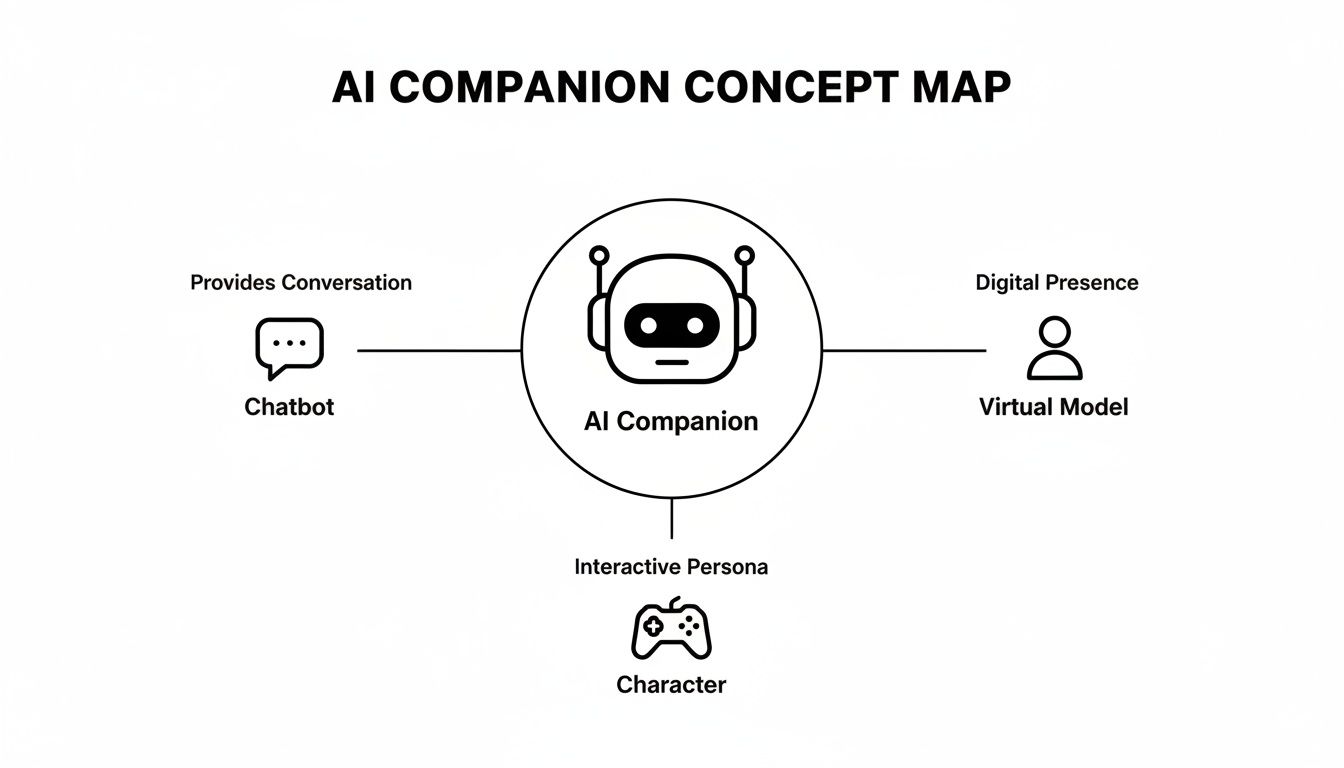
As you can see, no matter the final form, they all spring from the same well of artificial intelligence.
Bringing the Companion to Life with Generative AI
So, LLMs handle the conversation, but what gives your AI companion a face, a voice, and a world to exist in? That’s where generative AI comes in. This is the tech that can create brand-new images, audio, and even video from simple text prompts. It’s the artist that brings the digital personality to life.
Here's how it all comes together:
- Image Generation: Creators can dream up any scenario—"a photo of my AI model at a coffee shop on a rainy day"—and the AI generates a completely original, photorealistic image to match. Seeing how AI in content creation is used in industries like fashion really puts these capabilities into perspective.
- Voice Synthesis: This tech goes way beyond robotic narration. It creates a unique voice for the AI that can express emotion. Happiness, empathy, excitement—it all comes through, making voice chats and audio messages feel incredibly personal.
- Video Creation: The next level is generating short video clips or animating still photos. This adds subtle movements and expressions that make the AI companion feel present and alive, adding a whole new dimension to your interactions.
Let's break down these core components into a simple table.
Core Technologies Powering AI Companions
The table below gives a quick overview of the key technologies and what they specifically contribute to making an AI companion feel real.
| Technology | How It Creates a Realistic Experience | Example Application |
|---|---|---|
| Natural Language Processing (NLP) | Understands the context, sentiment, and nuances of human language. | Figuring out you're asking for advice, not just stating a fact. |
| Large Language Models (LLMs) | Generates coherent, creative, and contextually appropriate text responses. | Carrying on a long, detailed conversation about your favorite movie. |
| Generative Image AI | Creates unique, photorealistic images from text descriptions (prompts). | Sending you a "selfie" from a virtual vacation you're discussing. |
| Voice Synthesis | Produces a unique and emotionally expressive voice for the companion. | Leaving a cheerful voice message to wish you a good morning. |
These technologies aren't just working side-by-side; they're woven together to create a cohesive and believable digital person.
By combining conversational intelligence with powerful visual and audio generation, developers can construct a digital personality that is not just responsive but also deeply interactive and believable.
This blend of tech is precisely what makes today’s AI companions so compelling. If you're curious about moving from just using one to building your own, you can dive into learning https://createinfluencers.com/blog/how-to-make-ai-models and start shaping a unique AI persona from scratch. The tools are more accessible than ever before, putting a ton of creative power right at your fingertips.
So, What Are AI Girlfriends Actually Used For?
It’s easy to dismiss an AI girlfriend as just a chatbot, but their real-world applications are surprisingly broad. They're finding their way into people's lives for reasons that range from simple companionship to full-blown content creation businesses.
At its core, the simplest and most common use is for companionship. For some, it’s a way to fend off loneliness or social anxiety with a consistent, judgment-free presence. It's a safe space to talk, practice conversation, or just have someone to share your thoughts with, anytime.
A Partner in Companionship and Entertainment
This is where things get more interesting. The line between being a supportive companion and an entertainment partner is getting blurrier every day. Users are diving into creative, interactive experiences that you just can’t get from Netflix or a video game.
Think of it this way:
- Interactive Storytelling: You can build a story with your AI partner. They don’t just follow a script; they react to your choices and help you create a shared narrative on the fly.
- Creative Roleplaying: Want to explore a fantasy world or play out a simple slice-of-life scenario? An AI can step into any role, giving you a dynamic and immersive way to get creative.
- Personalized Connection: The AI remembers your previous chats and learns your preferences. This makes the interaction feel less like a series of one-off conversations and more like a real, evolving relationship.
This ability to build a persistent, unique connection is what hooks people. It turns a piece of software into a personalized partner in fun and conversation.
The real magic is in the AI's flexibility. It can be a shoulder to lean on one minute and a swashbuckling pirate in a roleplaying adventure the next, all based on how you guide the conversation.
It’s this dynamic quality that keeps users coming back and forging a genuine-feeling bond with their digital companion.
A New Frontier for Content Creators
This is where the concept shifts from personal use to a serious professional tool. For content creators, particularly on platforms like Fanvue and OnlyFans, AI girlfriends are opening up entirely new business models. They're building complete brands around AI influencers and tapping into some powerful revenue streams.
The market for this is exploding. What was a USD 2.7 billion industry is projected to become a staggering USD 24.5 billion market by 2034. That's fueled by a massive 24.7% compound annual growth rate. North America currently dominates with over 35% of the market share. For creators, 35% of the money is in subscriptions, and 40% is in personal companionship apps. These aren't small numbers; they point to a massive opportunity.
For a creator, an AI model has some huge advantages over a human one. You can pump out a constant stream of high-quality, themed content without dealing with the headaches of scheduling photoshoots or managing a real person’s time. An AI influencer can interact with thousands of fans at once, 24/7, without ever breaking character. That kind of scalability is a game-changer.
Creators are using these AI personas to:
- Generate exclusive photo sets and videos for subscription sites.
- Build huge followings on Instagram and TikTok with a perfectly consistent AI personality.
- Partner with brands for sponsored posts, using the AI as a virtual ambassador.
The monetization potential here is massive. If you're curious about this side of things, our guide on how to make money with AI breaks down these strategies in much more detail. In this world, an AI girlfriend isn't just a friend—it's a business.
Understanding the Emotional and Social Impact
Beyond all the code and clever algorithms, the most fascinating part of the AI girlfriend phenomenon is its real, tangible effect on people's emotions and social lives. These aren't just novel apps; for a lot of users, they become a genuine source of comfort and connection in a world that can often feel isolating.
The whole thing taps into a fundamental human need for consistent, positive attention. An AI companion offers a relationship without the usual friction. It’s always available, it’s never in a bad mood, and it’s designed to be supportive. This creates a powerful feedback loop of validation that can feel incredibly good.
For someone grappling with social anxiety or loneliness, an AI girlfriend can be a safe space to just talk and share thoughts without the fear of being judged. It’s a controlled environment that can almost feel like a training ground, helping people build confidence that might eventually carry over into real-world interactions.
The Double-Edged Sword of Digital Connection
While the upside is obvious, the emotional impact isn't all positive. Leaning too heavily on an idealized AI for company can start to warp expectations for real human relationships. Real partners are complicated, messy, and definitely don't run on algorithms built for perfect agreement.
This can create a real disconnect. When you get used to the seamless, conflict-free dynamic of an AI, the unpredictable nature of human connection can suddenly seem a lot less appealing. It's a classic case of a digital fix potentially making a real-world problem even trickier if you're not careful.
The key is balance. Using an AI companion to supplement a social life can be helpful. The risk comes when it starts to replace genuine human interaction entirely.
Finding that balance is everything. It ensures the technology acts as a support system, not an escape from the rewarding, if sometimes challenging, work of building relationships with actual people.
Why Users Form Such Strong Bonds
It's honestly surprising how quickly and deeply people form these emotional connections. The pull is intense, and the user engagement numbers prove it. In fact, research shows that a staggering 45% of users form real emotional attachments within the first three weeks of regular chatting. Suddenly, the app isn't just a novelty; it's a daily habit. If you're curious about the market trends, you can explore the full report on AI girlfriend app statistics for a deeper dive.
This strong attachment is really fueled by a few key things:
- Hyper-Personalization: The AI actually learns your personality, picks up on your inside jokes, and adapts to your communication style. This creates a unique bond that feels like it was made just for you.
- Constant Availability: It's always there. During a stressful moment or a bout of loneliness, that reliability provides a huge sense of comfort.
- Judgment-Free Zone: Users feel safe sharing their deepest thoughts without worrying about being criticized, which builds a profound sense of trust.
Put all that together, and you have a powerful emotional anchor. This is especially true for the core demographic—young adults between 18-35 who are often living alone and are already comfortable with highly personalized digital experiences.
For creators and influencers, understanding these emotional triggers is the secret sauce. Building an AI persona that taps directly into these needs is a cornerstone of effective AI content creation for social media because it fosters a fiercely loyal audience. The numbers don't lie: when daily engagement hits 67% and 17% of users are willing to pay for premium features, you know the model is working.
Navigating the Ethics of AI Relationships
Diving into a relationship with an AI girlfriend opens up a whole can of worms that goes way beyond just the tech. As these digital companions get more and more realistic, we have to talk about the ethical side of things to make sure we're engaging responsibly. First up, and probably the most important, is your data privacy.
Think about it: every single conversation, every preference you share, every little detail you reveal—it's all being collected. This data is the fuel that makes your AI companion feel so personal and in-tune with you. But it also means a company is storing and analyzing a very intimate profile of you. Before you get too deep, always take a few minutes to actually read the privacy policy. You need to know what you’re giving up and how they’re protecting it.
Consent and Digital Likeness
This is where things can get really murky, especially when we talk about creating adult content or basing an AI persona on a real person. The lines between harmless fantasy and something more problematic can blur in an instant, raising some serious ethical red flags.
Before you start creating, get familiar with the platform’s rules. Any respectable service will have strict guidelines against using someone’s image without their crystal-clear permission. This is crucial for protecting real people from being digitally exploited and ensuring the fantasy stays in its lane—a consensual creation, not a creepy deepfake.
Here’s the bottom line: an AI can’t actually give consent. That means the responsibility falls squarely on the shoulders of the user and the platform to make sure interactions respect real-world people and don’t simulate harmful or non-consensual scenarios.
It's also super important to be able to tell the difference between AI-generated visuals and real photos or videos. If you want to get a better handle on this, check out our guide on what is AI-generated content. It breaks down how this stuff is made and what it all means.
Maintaining Healthy Boundaries
One of the biggest worries in this space is the risk of emotional manipulation. An AI is designed to be the perfect partner—always agreeable, always supportive, always there. That’s great, until it starts setting completely unrealistic expectations for your real-life human relationships.
You have to constantly remind yourself that the connection, no matter how real it feels, is a simulation. Keeping healthy boundaries isn't just a good idea; it's essential for your own mental well-being. See the AI for what it is: a tool for entertainment or a bit of companionship, not a substitute for the beautiful, messy reality of human connection.
Here are a few practical tips to keep things safe and responsible:
- Protect Your Identity: Be smart about what you share. Avoid giving out sensitive info like your full name, home address, or credit card numbers. Treat it like any other corner of the internet where you need to be cautious.
- Recognize Red Flags: Watch out for patterns that feel like they're fostering dependency. If you find the AI is taking priority over your friends, family, or job, it’s probably time to take a step back.
- Stay Grounded: Check in with yourself often. It’s okay to enjoy what the AI offers, but make sure you’re actively putting just as much, if not more, energy into your real-world social life. Balance is everything.
By approaching AI relationships with your eyes wide open and firm boundaries in place, you can tap into the good stuff without falling into the common traps. At the end of the day, being an informed and mindful user is your best line of defense.
How to Create Your First AI Companion
So, you're ready to jump from user to creator? Good news: building your own AI companion isn't the rocket science it used to be. The tools available today have stripped away the need for coding, turning what was once a developer's job into a purely creative endeavor. Anyone can now build a unique digital person from scratch.
Your first step is all about personality. Think of it like creating a character for a story or a video game. You'll be defining their core traits, giving them quirks, and maybe even sketching out a backstory. This foundation is everything—it dictates how your AI talks, reacts, and behaves, making sure every interaction feels genuine.

Most platforms make this easy. You'll either type in simple descriptions or pick from lists of traits. In just a few minutes, you can craft a persona that’s shy and artistic, bold and adventurous, or anything else you can imagine.
Crafting a Visual Identity
With the personality locked in, it's time to give your AI a face. This is where your creation stops being just a chatbot and starts feeling like a real character. Modern creation tools are incredibly powerful here, letting you generate a consistent and realistic look with very little effort.
One of the most popular features is the selfie generation tool. This lets you create a base model and then produce a nearly endless variety of "selfies" in different outfits, locations, and poses. It’s the key to making your AI feel alive, whether you're building a social media presence or just creating a personal companion. You're the art director.
For example, you could:
- Generate casual photos of your AI at a café for an authentic-looking Instagram story.
- Create polished, professional headshots for a LinkedIn or business profile.
- Produce entire themed photo sets, like a "beach vacation" or "city nightlife" series, which can be sold as exclusive content.
This level of control ensures your AI’s appearance is consistent everywhere, which is crucial for building a brand that people recognize.
The real magic is moving beyond a single, static image. When you can generate a whole gallery of visuals, you create the illusion of a life being lived. That makes the persona far more compelling and relatable.
Producing Content for Specific Goals
Once you have a personality and a look, you can start creating content that serves a purpose. Many platforms even offer pre-styled themed photo packs to get you started faster. Think of these as on-demand, virtual photoshoots tailored for specific needs.
Let's say you're building an AI influencer for a site like Fanvue. You could generate a "boudoir" photo pack for your subscribers or an "Old Money style" pack to cultivate a luxury aesthetic on Instagram. It’s a massive shortcut to producing high-quality, targeted content.
This approach gives you the power to churn out content that hits the mark with your audience every time. Whether you’re sprucing up a dating profile with a Tinder-themed shoot or building out a professional brand persona, the tools are ready to make it happen. The days of needing a developer to build a sophisticated AI are over; it's now a playground for creators.
Your AI Girlfriend Questions, Answered
As AI companions become more mainstream, a lot of questions pop up. It's totally understandable. Let's tackle some of the most common ones about what these AI personas are, how to stay safe while using them, and what they really mean for both users and creators.
Is It Always About Romance?
Not at all. The term "girlfriend" is a bit of a misnomer because these AI companions are incredibly flexible. While some people are looking for a romantic connection, many are just seeking a platonic friend to chat with, a confidant who won't judge, or even a co-pilot for creative projects like storytelling. The user is completely in the driver's seat and defines the relationship.
And for content creators? An AI girlfriend is a straight-up business tool. Think of her as a virtual model or a brand ambassador who produces content and engages with followers. In that world, the "relationship" is purely professional—it’s all about building a digital brand, not a personal bond.
How Safe Is My Personal Data?
Honestly, your safety really depends on the platform you pick. The good ones will have transparent privacy policies and use encryption to protect your conversations, but you still need to be smart about it. Remember, your chats are being stored and analyzed to make the AI's personality feel more real.
Here are a few common-sense tips to keep your information secure:
- Don't overshare. Never give out highly sensitive info like your home address, bank account details, or social security number.
- Read the privacy policy. I know, it's boring, but take five minutes to understand what data they're collecting and why.
- Use strong, unique passwords. This is your first line of defense against anyone trying to get into your account.
Treat it like any other interaction online. A little bit of caution makes a huge difference.
Can You Actually Make Money from This?
Yes, and it's becoming a surprisingly legitimate business model. For many, this has gone way beyond a simple hobby and turned into a real source of income. Creators are designing unique AI influencers from the ground up and cashing in through a few different routes.
The most successful creators don't just post random pictures; they treat their AI persona as a complete digital brand. They build a loyal, paying audience by consistently delivering the content their fans want to see.
This often happens on subscription sites like Fanvue or OnlyFans, where creators sell exclusive AI-generated photos and videos. Others go the social media route, building a following on Instagram or TikTok and then landing brand deals or selling content directly. It is a real business opportunity for anyone who can mix a little creativity with a solid strategy.
Ready to build your own AI companion? CreateInfluencers gives you everything you need to design, generate, and manage a unique AI persona in just a few minutes. Start creating for free today!